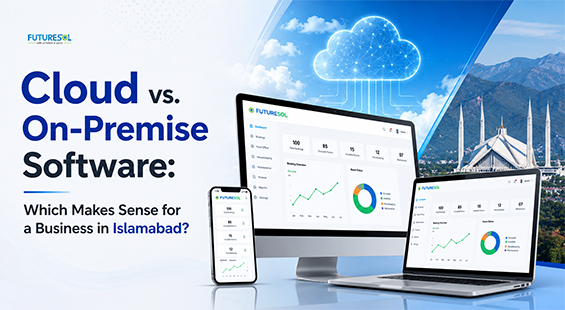
Cloud vs. On-Premise Software: Which Makes Sense for a Business in Islamabad?
Every growing business in Islamabad eventually faces this question. The honest answer depends less on the technology itself and more on your internet reliability, budget structure, and how much control you actually need.
Every growing business in Islamabad eventually faces this question. The honest answer depends less on the technology itself and more on your internet reliability, budget structure, and how much control you actually need.
Why this question keeps coming up
If you run a business in Islamabad, whether it's a school, a trading company, a manufacturing unit, or a chain of retail stores, you've probably had this conversation at least once: should we host our software ourselves, or should we just use whatever runs in a browser?
Ten years ago, the answer was usually on-premise by default because cloud infrastructure in Pakistan was inconsistent and expensive. That's no longer true. Today the decision is genuinely close, and it depends on factors specific to your business rather than a blanket rule.
What the Two Models Actually Mean
On-premise software runs on a server physically located at your office or in a local data center you control. Your team manages the hardware, backups, security patches, and uptime.
Cloud software runs on servers managed by your vendor, accessed through the internet from any device. You don't manage hardware; you manage a subscription and an internet connection.
The Factors That Actually Matter in Islamabad
1. Internet Reliability at Your Specific Location
This is the single biggest practical factor for any Islamabad business, and it's rarely discussed honestly.
Some areas generally have stable fiber connectivity. Some industrial zones and outskirt locations still experience frequent outages or inconsistent speeds.
If your internet drops for an hour every few days, a fully cloud-dependent system means your team can't work during that hour. A hybrid or on-premise setup with local caching avoids that specific risk.
2. Upfront Budget vs. Ongoing Budget
On-premise software usually means a larger upfront cost, servers, licenses, and IT setup, followed by lower ongoing costs.
Cloud software flips this: little to no upfront hardware cost, but a recurring monthly or annual subscription.
Businesses with available capital but tight monthly cash flow often prefer on-premise. Businesses that want to avoid large upfront spending, especially startups and SMEs, lean toward cloud.
3. In-House Technical Capacity
On-premise software needs someone to manage it, patching, backups, hardware failures, and security.
If you don't already have IT staff, on-premise effectively means hiring one, which is a real and recurring cost most SMEs underestimate.
Cloud software shifts this responsibility to the vendor, which is precisely why most small and mid-sized businesses in Islamabad without a dedicated IT department default to the cloud.
4. Multi-Location or Remote Access Needs
If your business has more than one branch, say a school with two campuses, or a retail chain with stores across Islamabad and Rawalpindi, cloud software is almost always the simpler choice.
On-premise setups require either a server at every location or a VPN connection back to a central server, both of which add complexity.
Cloud systems are accessible identically from every branch with no extra infrastructure.
A Side-by-Side Comparison
| Factor | On-Premise | Cloud |
|---|---|---|
| Upfront cost | High (servers, licenses) | Low to none |
| Ongoing cost | Lower, but includes IT staff | Recurring subscription |
| Internet dependency | Low (works on local network) | High (needs stable internet) |
| Maintenance burden | On your team | On the vendor |
| Multi-branch access | Complex (VPN/extra servers) | Simple (same login anywhere) |
| Data control | Full, physical control | Depends on vendor & contract |
| Scalability | Needs new hardware to scale | Scales instantly |
A Simple Way to Decide
On-Premise Is Likely the Better Fit If Your Business:
- Operates from a single location with stable internet not guaranteed
- Has regulatory or contractual requirements to keep data on-site
- Already has IT staff who can manage servers
- Has available upfront capital and prefers lower long-term recurring costs
Cloud Is Likely the Better Fit If Your Business:
- Operates from multiple branches or needs remote access
- Doesn't have dedicated IT staff and doesn't want to hire for it
- Wants to avoid large upfront infrastructure costs
- Is growing and doesn't want to predict server capacity years in advance
The Hybrid Option Most Businesses Don't Know Exists
Increasingly, businesses in Islamabad don't have to choose one extreme.
A hybrid setup, core data hosted locally with cloud access layered on top, or a cloud system with offline-capable mobile apps that sync once internet returns, solves the internet reliability problem without giving up the flexibility of cloud access.
This is worth asking your software vendor about directly, since not every provider offers it.
The Bottom Line
There's no universal right answer between cloud and on-premise for businesses in Islamabad; there's only the right answer for your specific situation: your locations, your internet reliability, your budget structure, and your in-house capacity.
The mistake most businesses make isn't picking the wrong model; it's picking a model and never revisiting the decision as the business grows.
If you're trying to figure out which approach fits your business, talk to the Futuresol team about what makes sense for your specific operation.
Futuresol Tech builds custom software and ERP solutions for businesses across Pakistan, UAE, and Saudi Arabia, with both cloud-based and on-premise deployment options tailored to each client's operational needs. Learn more at futuresol.net