How Dubai Hotels Manage 100+ Rooms Without a Full-Time IT Team
Hiring a full IT department is expensive and, for most mid-sized hotels is unnecessary. Dubai's busiest properties are running smoothly with a lean team and the right hospitality management system instead.
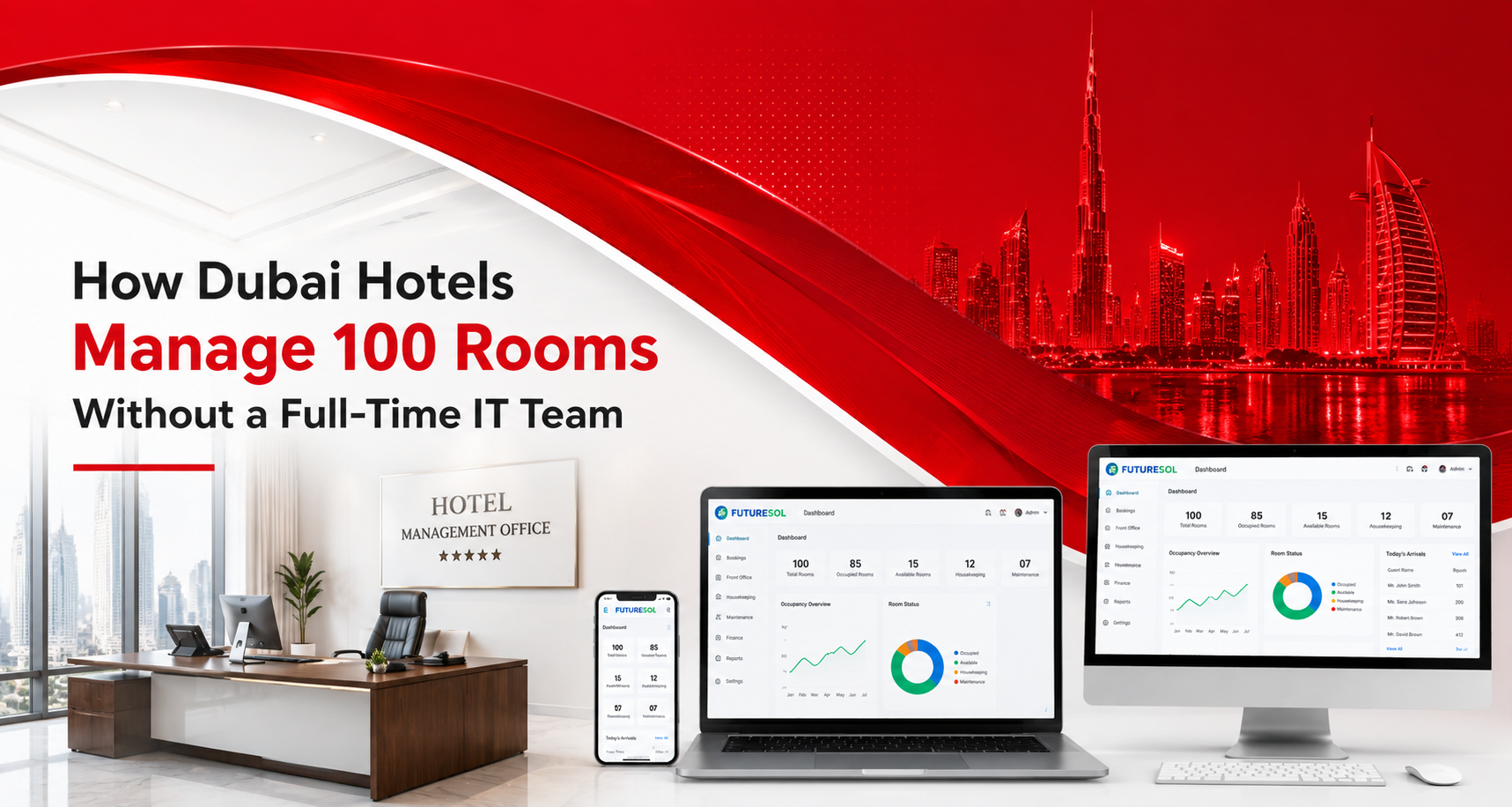
Hiring a full IT department is expensive and, for most mid-sized hotels is unnecessary. Dubai's busiest properties are running smoothly with a lean team and the right hospitality management system instead.
The Myth of Needing an IT Department
Walk into almost any 4-star hotel in Dubai with 100 to 250 rooms and ask to meet their IT team. In most cases, you'll meet one person, sometimes shared with another property in the same group. Yet these hotels run front desk operations, housekeeping, point of sale, channel management, and guest communication without a single major outage during peak season.
This isn't because Dubai hotels are unusually lucky with technology. It's because the entire operating model has shifted. The heavy lifting servers, security patches, backups, uptime, no longer sits with an in-house team. It sits with the software vendor.
What Actually Replaced the IT Department
1. Cloud-Based Property Management Systems
A decade ago, a 100-room hotel needed an on-site server room, a dedicated network engineer, and someone available 24/7 in case that server crashed at 2am during a full house.
Today, that entire stack lives in the cloud. The hotel needs a stable internet connection and a browser, nothing else. Updates, security patches, and backups happen automatically on the vendor's side, with zero involvement from hotel staff.
2. One System Instead of Six Disconnected Systems
Most of the technical fragility in hotel operations doesn't come from any single system failing it comes from the integrations between systems breaking. A property management system that doesn't talk properly to the point-of-sale, which doesn't sync with the channel manager, which doesn't update the booking engine that's where IT tickets pile up.
Dubai hotels that run lean increasingly choose a single hospitality ERP that covers reservations, housekeeping, POS, and reporting in one platform, removing the integration points that used to break.
3. Vendor-Managed Support Contracts
Instead of an internal helpdesk, hotels rely on their software vendor's support team. A front desk agent who can't process a check-in calls the vendor's support line, not an internal extension.
This works because UAE-based hospitality software providers understand the operational urgency of a hotel a ticket at midnight gets a different response time than a ticket from a retail business.
4. A Trained Super-User Instead of an IT Specialist
Almost every lean hotel has one person who is often the front office manager or a senior receptionist who knows the system inside and out. This person isn't a technical hire. They're trained during onboarding to handle 90% of day-to-day questions: room status corrections, rate adjustments, and basic report pulls. The remaining 10% is anything structural that goes to the vendor.
5. Mobile-First Operations
Housekeeping staff update room status from a phone, not a shared terminal. Maintenance requests are logged and closed from a tablet. This removes a huge chunk of the hardware management problem, and there's no fleet of aging desktop PCs to maintain, image, or troubleshoot across departments.
Futuresol Tech provides a cloud-based hospitality management platform for hotels and restaurants across the UAE, Saudi Arabia, and Pakistan covering front desk, housekeeping, point of sale, and reporting in a single connected system. Learn more at futuresol.net
Where This Approach Has Limits
This model works well for hotels up to roughly 250 to 300 rooms with relatively standard operations. Larger resorts, properties with extensive on-site infrastructure such as multiple restaurants and large conference facilities, or hotels running heavily customized integrations still benefit from a dedicated technical point of contact, though even then, it's increasingly a small team rather than a full department.
The key factor isn't room count alone; it's how many disconnected systems the hotel is running. A property with 200 rooms on one unified platform needs far less technical support than a property with 80 rooms running five separate, poorly integrated tools.
What to Look for If You Want to Run Lean
Hotels that want to reduce IT dependency should choose a technology platform that supports complete operational management.
- A genuinely cloud-native system, not an on-premise system with a web login bolted on
- One platform covering front desk, housekeeping, and POS rather than three separate vendors
- A support team based in the same region and time zone, with response times suited to 24/7 operations
- Clear onboarding that trains at least one internal super-user properly
The Future of Hotel IT Management
Dubai hotels running 100+ rooms without a full-time IT team aren't cutting corners; they've simply moved the technical burden to where it belongs: with a cloud vendor whose entire business is keeping that system running.
What's left for the hotel is operational, not technical: one trained super-user, a reliable support contract, and a single connected platform instead of a patchwork of disconnected tools.
If your hotel is still juggling separate systems for reservations, POS, and housekeeping, talk to the Futuresol team at futuresol.net about consolidating onto a single cloud hospitality platform.
Frequently Asked Questions
Run Your Hotel Operations Without IT Complexity
Manage front desk, housekeeping, POS, reporting, and hotel operations through a powerful cloud hospitality platform designed for modern hotels and restaurants.
Request a Free Demo