5 Signs Your School Is Ready for an ERP System (and 3 Signs It's Not)
The right time to implement a school ERP isn't when things are falling apart, it's just before that. Here's how to tell which side of that line you're on.
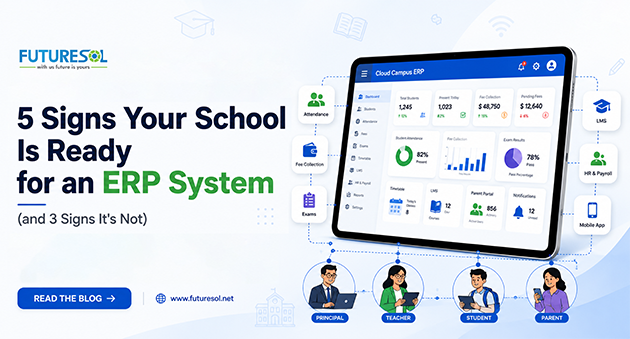
The right time to implement a school ERP isn't when things are falling apart, it's just before that.
Here's how to tell which side of that line you're on.
Every school principal, administrator, and owner eventually faces a version of the same conversation: should we get a proper school management system?
The question usually comes up during admission season chaos, when fee collection is a mess, or when a parent asks a question about their child that nobody can answer without checking three different registers.
But the honest answer to "are we ready" is more nuanced than most ERP vendors will tell you.
Sometimes the timing is right and a system will transform how the school operates. Sometimes the timing is wrong, and the same system will create more disruption than it solves, not because the software is bad, but because the school wasn't in the right position to absorb it.
Here is how to read the signals honestly.
Part One: 5 Signs Your School Is Ready
1. Fee Collection Is Manual and Reconciliation Takes Days
If your accounts team spends the first week of every month manually cross-referencing fee receipts with a register, chasing parents for outstanding payments on the phone, and reconciling cash collections against handwritten records, that process is both time-consuming and error-prone.
Fee leakage, missed follow-ups, and the inability to instantly tell a parent their exact balance are all symptoms of a manual fee system that has outgrown what it can handle.
A school ERP automates the entire fee cycle, generating challan slips, tracking payments, sending automated reminders, and producing a real-time receivables report the accounts team can pull in thirty seconds.
When your current process is costing you more in staff time and errors than a system subscription would cost, you're ready.
2. Admission Season Is Your Most Stressful Month of the Year
Admissions by paper form is manageable when a school takes in 50 new students a year. At 200 or 300, it becomes a logistical challenge that consumes the principal's office for six weeks.
Forms get misfiled, sibling discounts get miscalculated, applicant statuses can't be tracked in real time, and the team answering parent phone calls doesn't have reliable information to give.
Every year the chaos is slightly worse than the last, because the school is growing faster than the manual process can handle.
When admissions season has become a recurring operational crisis rather than just a busy period, that's a clear signal.
A school ERP with an online admissions module allows parents to apply digitally, lets staff track every application in one place, automates status notifications, and produces class allocation reports without anyone manually sorting through a stack of paper.
3. Parents Are Asking Questions Your Staff Can't Answer Quickly
A parent calls to ask about their child's attendance last month. The receptionist has to find the class register, call the class teacher, wait for a response, and call the parent back.
A parent visits to ask why their fee challan shows a different amount than last month. The accounts person has to manually search through receipts and a notebook to reconstruct the history.
These interactions are not failures of the people involved, but they're failures of a system that doesn't make information accessible.
When your front desk staff regularly can't answer parent queries without a significant delay, the school's professional image takes a quiet but consistent hit.
Parents notice when a question about their child requires three phone calls to resolve.
A school ERP with a parent portal puts attendance, results, fee history, and announcements on the parent's own phone, removing the query load from staff entirely.
4. You're Operating More Than One Campus
A second campus multiplies the complexity of almost every administrative task.
- Fee collection across two sites.
- Attendance consolidated from two sets of class registers.
- Staff payroll split across two locations.
- Results managed in two separate systems.
- Reporting that has to be manually combined at the end of each term before the principal can see the full picture.
Multi-campus visibility is one of the clearest arguments for a proper school ERP.
When a principal or owner can log in and see every campus, every class, every fee account, and every attendance record from one screen, the operational overhead of running multiple campuses drops dramatically.
If you're about to open a second branch, implementing a system before you open is far easier than implementing it after the second site is already running manually.
5. You Can't Produce a Reliable End-of-Term Report Without Significant Manual Effort
End-of-term reporting is the moment a school's information management either works or reveals its gaps.
If producing result cards requires teachers to submit marks on paper, someone to manually enter them into a spreadsheet, someone else to format and print the report cards, and a final manual check before they go home, that's a three-to-four-day process for a team of people that could be automated almost entirely.
Beyond result cards, consider attendance summaries, fee status reports, and teacher performance records.
If pulling any of these together takes more than an hour, the data infrastructure isn't serving the school's leadership effectively.
Good decisions require accessible, accurate data, and a manual system makes that harder as the school grows.
Part Two: 3 Signs Your School Is Not Ready Yet
ERP vendors rarely say this, but implementing software too early can be just as problematic as implementing it too late.
1. Your Internal Processes Still Change Every Month
Software should automate stable processes, not processes that nobody has agreed on yet.
If the admissions workflow changes every intake, fee structures are rewritten every quarter, or staff responsibilities shift constantly, implementing an ERP simply automates inconsistency.
Stabilize the process first. Automate second.
2. Leadership Hasn't Agreed on How the School Should Operate
An ERP requires decisions.
Who approves admissions? Who authorizes fee discounts? Who can edit attendance? Which reports matter most?
If the management team doesn't yet agree on these questions, the software won't solve the disagreement.
It will simply make the disagreement more visible.
3. Staff Have Received No Preparation for Change
The biggest reason ERP implementations fail isn't technical.
It's cultural.
Teachers, administrators, and finance staff who have worked one way for years naturally need time, training, and support to adopt a new system.
Schools that invest in change management alongside software implementation consistently achieve better results than those that assume everyone will simply adapt automatically.
How Futuresol Approaches School ERP Implementation
At Futuresol, we don't begin with software.
We begin with the school.
Every implementation starts with understanding how admissions, fee collection, attendance, examinations, communication, HR, and finance currently operate.
We identify what already works, what creates unnecessary manual effort, and where automation will have the greatest impact.
Rather than forcing every institution into an identical structure, Cloud Campus ERP is configured around each school's operational requirements, ensuring the system supports existing workflows while introducing improvements where they deliver measurable value.
Our implementation team also provides onboarding, staff training, data migration, and post-deployment support so schools transition smoothly without disrupting daily academic operations.
The Bottom Line
Schools don't implement ERP systems because technology is fashionable.
They implement them because manual administration eventually reaches its limit.
If your school recognizes several of the readiness signs above, it's probably the right time to explore a modern school management system.
If you recognize more of the "not ready" signs, the better investment may be process improvement first, followed by technology.
The best ERP implementation isn't the fastest.
It's the one introduced at exactly the point where the school is ready to benefit from it.
Frequently Asked Questions
Transform Your School with Cloud Campus ERP
Streamline admissions, fee collection, attendance, examinations, HR, finance, and parent communication with Cloud Campus ERP. Discover how Futuresol can help your institution digitize operations and support future growth.
Request a Free DemoLatest Articles
-

How Much Does a School ERP Cost in Pakistan?
21 Oct, 2026 -

-

-
-
-