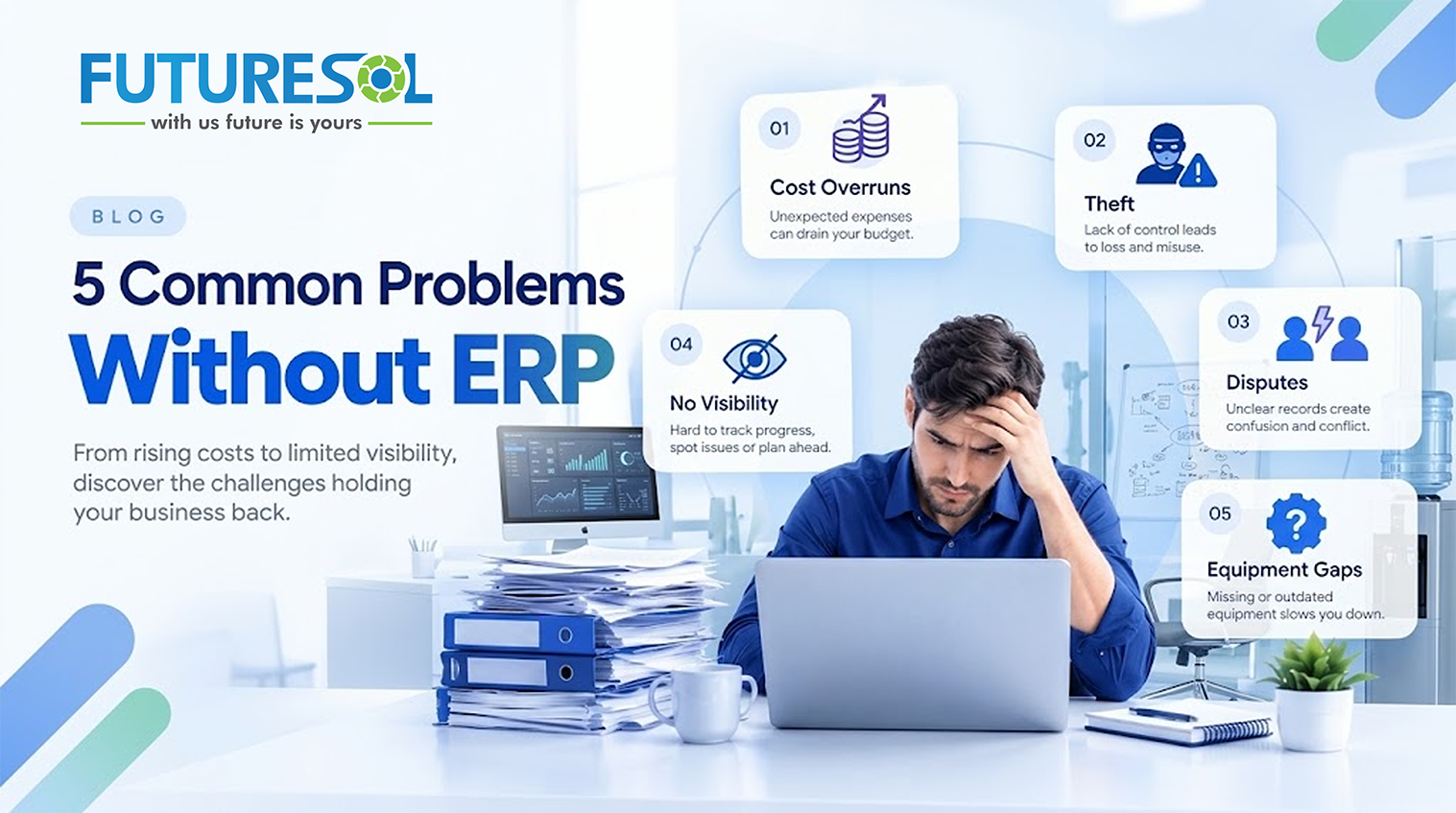
5 Common Problems Without ERP (Cost Overruns, Theft, Disputes, No Visibility, Equipment Gaps)
Construction is one of the most complex businesses to run in Pakistan and one of the least digitised. This guide explains what an ERP does for a construction business, what to look for, and how Futuresol's construction management platform fits in.
ERP Software for Construction Companies in Pakistan
Construction is one of the most complex businesses to run in Pakistan and one of the least digitised. Most construction companies are managing multi-crore projects on a combination of Excel sheets, WhatsApp messages, and handwritten site registers. This guide explains what an ERP does for a construction business, what to look for, and how Futuresol's construction management platform fits in.
By Futuresol Tech | Construction Technology
Why Construction Companies in Pakistan Need an ERP
A construction company isn't just one business, it's several running simultaneously. At any given time, you might be managing five active project sites, a procurement team placing material orders, subcontractors billing for completed work, a finance team trying to track costs against budgets, and a compliance team renewing labour licences and equipment certifications.
When each of these functions runs on its own system or no system at all, the result is predictable: cost overruns that aren't caught until month-end, material shortages that stop site work, subcontractor disputes over payment records, and project delivery delays that damage client relationships.
An ERP connects all of these functions into one platform. A project manager in Islamabad can see the material consumption on a Lahore site in real time. A finance director can see actual spend against budget without waiting for a weekly report. A procurement officer knows what stock is on which site before placing a new order.
What a Construction ERP Should Cover
Not all ERP systems are built for construction. A generic business ERP handles accounts and HR but has no concept of project-based costing, bill of quantities, or site-level material tracking. Here is what a construction-specific ERP should include:
| Module | What It Does |
|---|---|
| Project Management | Track milestones, timelines, and deliverables across multiple active projects simultaneously. |
| Budget & Cost Control | Set project budgets, track actual spend in real time, and flag overruns before they become problems. |
| Procurement & Materials | Raise purchase orders, manage vendor quotes, track deliveries, and control material usage per site. |
| Inventory & Site Stock | Know exactly what materials are on which site, reduce theft and wastage, and avoid duplicate purchasing. |
| Subcontractor Management | Track work orders, progress claims, and payments to subcontractors with a clear audit trail. |
| Labour & Attendance | Log daily site labour headcount, track hours, and generate accurate payroll for daily-wage workers. |
| Equipment & Asset Tracking | Monitor machinery utilisation, maintenance schedules, fuel consumption, and equipment compliance. |
| Financial Reporting | Project-level P&L, cash flow forecasting, retention tracking, and client billing from one dashboard. |
The Most Common Problems Pakistani Construction Companies Face Without an ERP
1. Cost Overruns Discovered Too Late
When project costs are tracked manually receipts collected at the end of the week, entered into Excel by an accounts clerk, the picture you're looking at is always two weeks old. By the time you know a project is 15% over budget, it's usually 20% over. An ERP tracks every purchase order and material request in real time, so cost variance is visible the day it happens, not the week after.
2. Material Theft and Site Wastage
Construction sites in Pakistan lose significant material value every year to a combination of theft, wastage, and inaccurate recording. When materials are issued from a store without a digital record, there's no way to reconcile what was ordered, what was delivered, what was issued to site, and what was used. An ERP with site-level inventory tracking creates that reconciliation automatically, making discrepancies visible.
3. Subcontractor Payment Disputes
Disputes over subcontractor payments are one of the biggest causes of project delays in Pakistan. When work completion is recorded informally — a WhatsApp message, a verbal confirmation on site — there's no clean record to refer to when a payment is disputed. An ERP creates a documented trail from work order to completion certificate to payment, giving both parties a clear reference point.
4. No Visibility Across Multiple Projects
A construction company running three or four projects simultaneously needs to see the health of all of them from one place. With manual systems, the only way to get that view is to collect reports from three different site managers, consolidate them into a spreadsheet, and hope the numbers are accurate. By the time that's done, the information is already stale.
5. Equipment Downtime and Compliance Gaps
Heavy machinery that isn't maintained on schedule costs more to repair than to maintain. Equipment with expired certifications creates regulatory exposure on the site. Without a system tracking maintenance schedules and certification expiries, both of these are managed by memory and memory fails.
What Does a Construction ERP Actually Save?
Construction companies that implement a proper ERP consistently report savings in three areas:
- Material cost reduction: Better procurement planning and site inventory tracking typically reduces material waste and duplicate purchasing by 8–15%. On a Rs. 5 crore project, that's Rs. 40–75 lakh in recoverable cost.
- Labour cost accuracy: Digital attendance and payroll for daily-wage labour eliminates the ghost worker problem, workers on the payroll who aren't on site. This is one of the most common sources of cost leakage in Pakistani construction.
- Project delivery time: Projects managed through a proper system with milestone tracking and procurement alerts consistently finish closer to their original timeline than those managed manually, because delays are flagged earlier.
- Management time: Directors and project managers who spend hours compiling site reports get that time back. A live dashboard replaces a weekly reporting cycle.
Where Futuresol's Construction ERP Fits In
Futuresol has built its construction management platform specifically for Pakistani contractors, developers, and project management companies, which means it handles the workflows that Pakistani construction businesses actually use, not a generic international template that needs to be heavily customised before it makes sense locally.
The platform covers the full project lifecycle: from initial budget and BOQ setup through procurement, material management, subcontractor billing, labour attendance, equipment tracking, and final project accounts all connected in one system.
What Makes Futuresol's Construction ERP Worth Considering?
- Built for Pakistani construction workflows: BOQ-based costing, local vendor management, daily-wage labour payroll, and retention tracking all configured for how Pakistani projects are actually run.
- Multi-project visibility: See budget vs. actual, material consumption, and milestone status across all active projects from one dashboard, in real time.
- Site-level material tracking: Every material issued to site is logged digitally, creating a clear record that reconciles against deliveries and purchase orders.
- Subcontractor and vendor management: Work orders, completion certificates, and payment records kept in one place, reducing disputes and making audits straightforward.
- Mobile access for site teams: Site engineers and supervisors can log attendance, material issues, and progress updates from a mobile app no need to wait until they're back at the office.
- Local implementation team: Futuresol's team is based in Pakistan and handles setup, data migration, and training so you're not figuring out a new system on your own.
Construction companies that move from manual tracking to Futuresol's platform typically recover the cost within the first project through reduced material wastage and labour leakage alone with the operational benefits compounding across every project after that.
Questions to Ask Any Construction ERP Vendor Before You Commit
- Does the system handle BOQ-based project costing, or is it a generic project management tool?
- Can it track material inventory at the individual site level across multiple projects?
- How does the system handle daily-wage labour attendance and payroll?
- Is there a mobile app for site teams, or is it desktop-only?
- Who handles the implementation and data setup the vendor or us?
- Can we see a demo using a project structure similar to ours, not a generic sample?
See How Futuresol's Construction ERP Works for Your Business
Whether you're running two projects or twenty, we'll show you exactly how the platform handles your specific workflows procurement, site materials, subcontractors, labour payroll, and project accounts, in a live demo built around your operation.
Book a DemoAbout Futuresol Tech
Futuresol Tech builds custom software and ERP solutions for construction, real estate, education, hospitality, and transport businesses across Pakistan, UAE, and Saudi Arabia. Our construction management platform covers the full project lifecycle from BOQ and budgeting through procurement, site management, subcontractor billing, and project accounts in a single connected system.
Learn more at futuresol.net.
Latest Articles
-

How Much Does a School ERP Cost in Pakistan?
21 Oct, 2026 -

-
-
-

-